“The Horse Is Here to Stay”: What the Automobile Can Teach Us About AI in Our Kids' Education
Aug 2026 · 8 min read
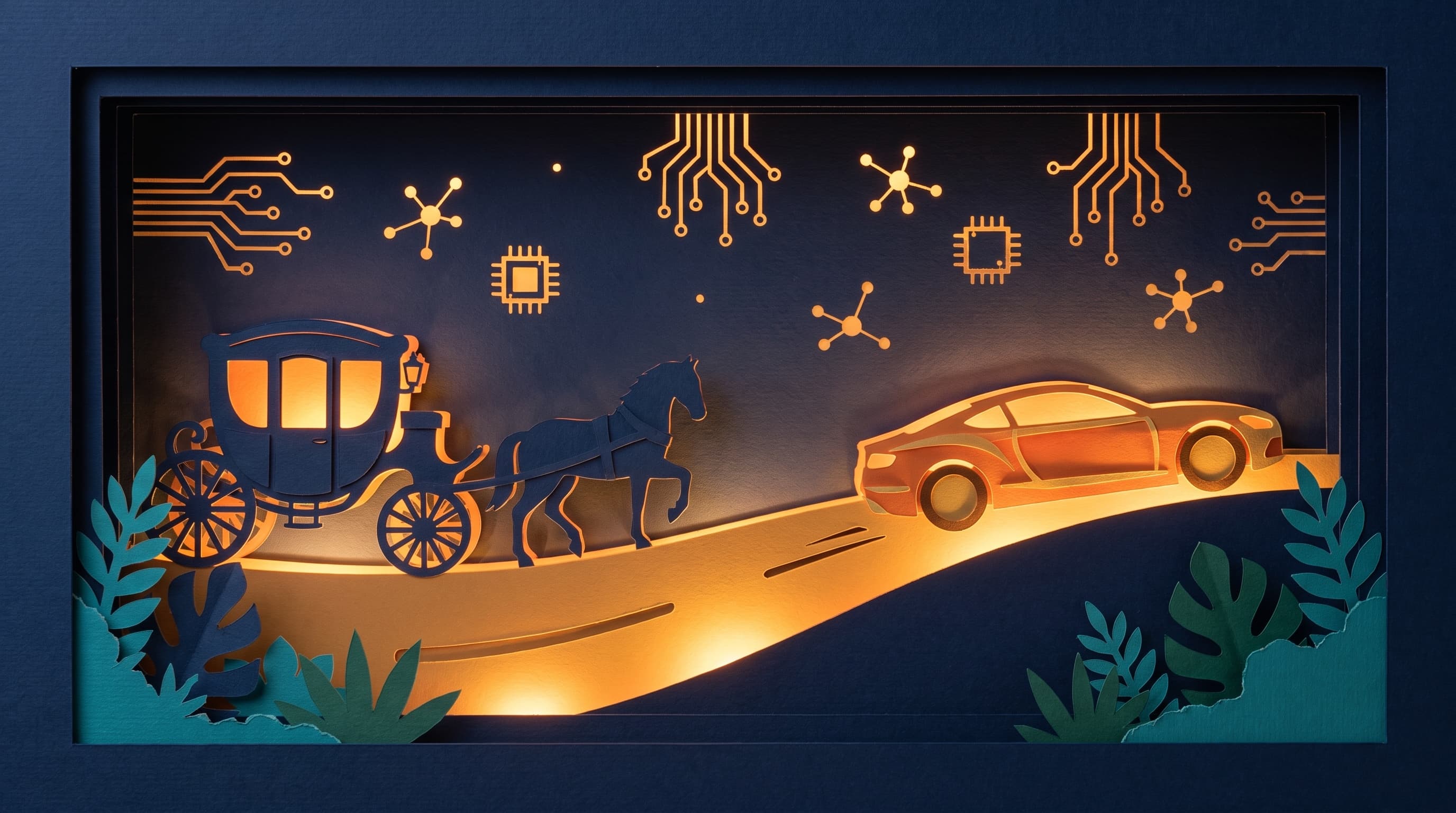
In 1903, a Michigan banker sat down with an attorney who was considering putting money into a scrappy new company called the Ford Motor Co. His advice, recorded in Sarah T. Bushnell's The Truth About Henry Ford, was blunt:
“The horse is here to stay, but the automobile is only a novelty — a fad.”
He wasn't alone. In 1900, horse dealers in Washington, D.C. dismissed the automobile as little more than a passing curiosity — one they figured wouldn't even have the staying power of the bicycle. The complaints were specific: the engine noise would wear on people's nerves, the exhaust smelled terrible, and no self-respecting lady would ride in a carriage next to something that spooked the horses.
They weren't stupid. They were looking at the evidence in front of them — a loud, smelly, unreliable machine that broke down constantly and needed roads that mostly didn't exist yet — and reasoning from it. What they couldn't see was the curve.
The Curve, in Numbers
In 1900, there were about 8,000 registered motor vehicles in the entire United States — and more than a third of those were electric, not gasoline. Seven years later, that number had climbed past 140,000. By 1925, it was over 12 million. By the end of the 1920s, registered drivers had nearly tripled to 23 million in a single decade.
That's not gradual, steady adoption. That's a hockey stick — decades of “fad” followed by a takeover so complete that within one generation, the horse-drawn carriage went from the default way to get anywhere to a novelty at a fairground.
Today, 91.5% of U.S. householdsown at least one vehicle, and the average household owns 2.28 of them. There are nearly 297 million registered vehicles in the country. The “fad” became so central to daily life that most of us couldn't describe how our week would function without it.
AI in Our Kids' Classrooms Is on the Same Curve — And It's Moving Faster
Here's the thing about the automobile skeptics: they had decades to come around. The AI curve in education is compressing that same arc into a handful of school years.
Consider what's already true, right now, in 2026:
- 64% of U.S. teens aged 13–17 now use AI chatbots, and 54% specifically use them for schoolwork, according to Pew Research Center.
- 88% of studentsused generative AI for assessments in 2025 — up from just 53% the year before. That's not a slow climb. That's the same kind of jump the automobile saw between 1900 and 1910.
- Teacher adoption has nearly doubled in three years, rising from 34% in 2023 to 61% in 2026. In broader surveys, 83% of K-12 teachers report using generative AI in some form.
- Teachers who use AI tools weekly are saving an average of 5.9 hours per week— roughly six extra weeks of reclaimed time across a school year. That's six weeks back for actual teaching, actual connection, actual kids.
Student use jumped 26% and educator use jumped 21% in a single school year. Whatever you think about AI personally, the data says the same thing the vehicle registration numbers said in 1907: this isn't a fad that's fading. It's a fad that's becoming the default.
Skepticism Isn't the Problem — Denial Is
To be clear: the 1900s horse dealers weren't villains, and we're not here to mock caution. Healthy skepticism about a new technology is reasonable, especially when it's your child's education on the line. Cars really were dangerous before seatbelts, traffic laws, and paved roads caught up. AI really does raise legitimate questions about critical thinking, screen time, and what kids should be doing with their own two hands and their own two eyes instead of a screen.
But there's a difference between skepticism — asking hard questions, setting boundaries, choosing tools carefully — and denial— pretending the shift isn't happening and hoping your kids can opt out of the world they're going to grow up and work in.
The families who thrived through the automobile transition weren't the ones who refused to ride in a car on principle. They were the ones who learned to drive well, understood the rules of the road, and used the technology deliberately instead of recklessly. The same choice is in front of homeschooling parents right now.
What This Means for How You Homeschool
Your children are going to grow up in a world where AI is as unremarkable as a car in a driveway. The question isn't whether that happens — the numbers above say it's already well underway — it's whether they grow up knowing how to use it thoughtfully, or whether they encounter it for the first time unprepared, the way a teenager might get behind the wheel with no driver's ed.
That's not an argument for handing a nine-year-old an unsupervised chatbot. It's an argument for the same thing homeschooling has always been good at: teaching a skill deliberately, in context, with a parent who's actually paying attention — instead of leaving it to chance.
The horse dealers of 1900 weren't wrong that the automobile would change everything. They were only wrong about which direction it would change. Embrace the shift, don't deny it — and make sure your kids are in the driver's seat, not just along for the ride.
Curious how LoveLed uses AI thoughtfully in your family's homeschool?